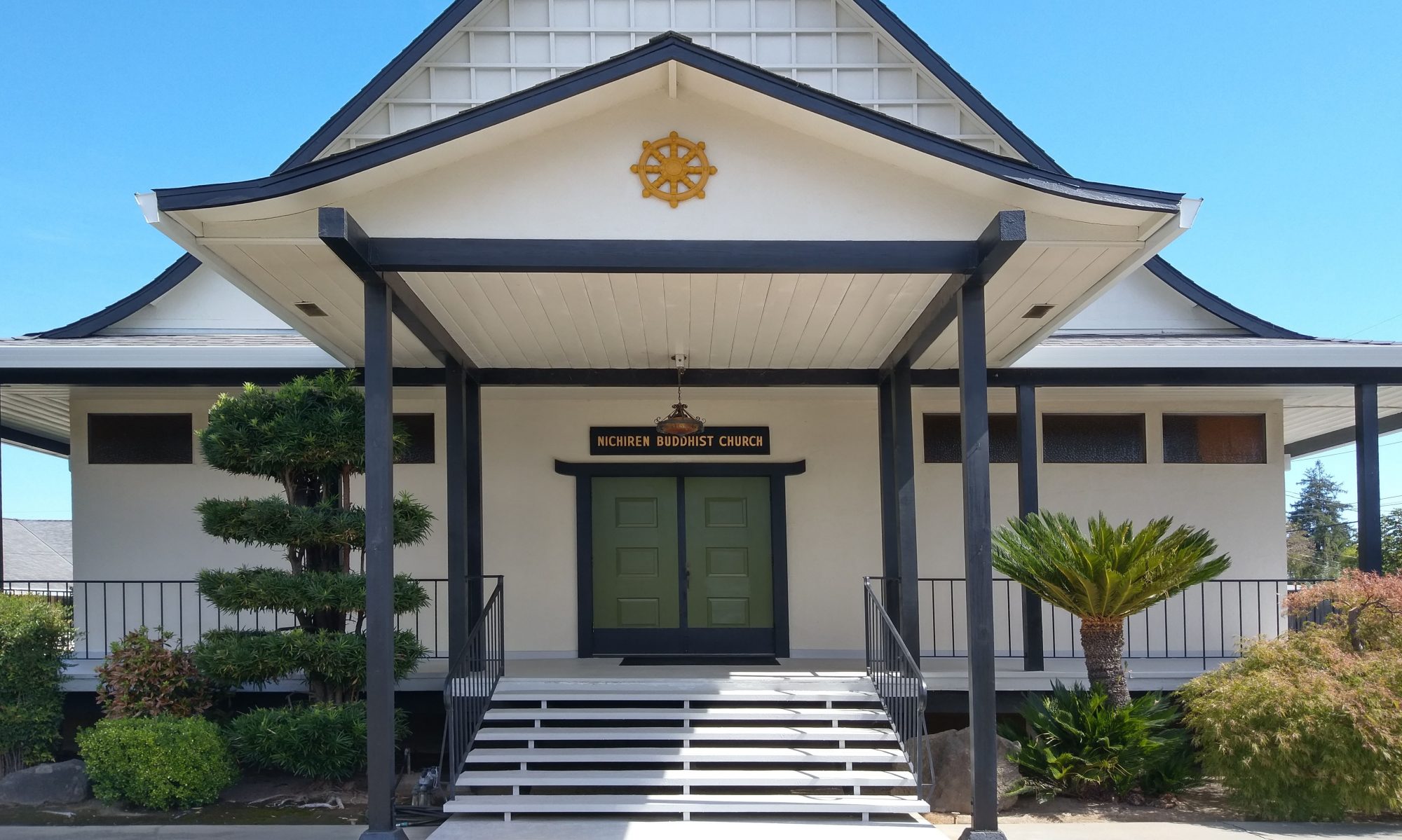
I hope everyone is doing well and finding ways to stay cool as we make our way into the summer months of Sacramento. Despite the changing weather, like many, I have a set routine that stays consistent throughout the year. Come to think of it, my routine has not changed for several years, even decades! My morning routine starts with waking up at 3:00am, preparing food offerings for the various altars, then going to the temple for my prayer at 3:30am. I should mention that at the Nichiren Shu 100-day ascetic aragyo training, we would start with “water prayer” at 3:00am, then move to the main temple at 4:00am to continue with chanting the sutra. Part of my routine is influenced by my aragyo training – even now, I start by chanting Nichiren Shonin’s kito prayer. I subsequently chant one full volume of the Lotus Sutra (8 volumes), taking me a total of eight days to cycle through the whole sutra. I finish my prayer at 5:00am, eat breakfast, then go on my daily hour-long walk at 6:00am.
Admittedly, I sometimes find myself going through some of the movements, like preparing for my walk, without too much thought. In a way, it has become somewhat of a habit. For my walks, I take the exact same path, expect to be at certain checkpoints at a particular time, and greet the same neighbors. But throughout the years of continuing my routine, I have also found the importance of taking the time to notice certain aspects that were not as obvious before. For example, it was surprising to realize how many coins I was able to spot on the side of the road during my walks. Of course, most of these coins were pennies, and very rarely would I spot a quarter. Whenever I would find these coins, I would bring them back to the temple and put them into the “Offering Box” that we have at the entrance. Last year, when Mr. Joe Hitomi, the temple treasurer, opened the “Offering Box” for the first time in several years, I was surprised to hear that out of the >$1,200 in donations, there were >$40 in just coins!
Many may ask why I take the time to put these coins into the “Offering Box.” My reason for doing this has to do with the following Japanese Buddhist phrase: “en naki shujyō wa doshigatashi” (縁なき衆⽣は度し難し). This is commonly translated as “those who do not have connections to the Buddha’s teachings or are unwilling to accept them, will not be saved.” This translation has somewhat of a negative connotation. However, I would like to propose a slightly different interpretation based off of my studies of Buddhist literature, my practice, and my experience as a minister in the US. It is that “unfortunately, those who do not have opportunities to learn about the teachings of the Buddha will have difficulty making connections to and reaping the benefits of these teachings”. This “connection” (en) is extremely difficult to make, especially in countries like the US, where Buddhism is of course not the predominant religion. We have to put in extra effort so that more of these opportunities and thus connections can be made. My hope is that this seemingly simple action of placing these coins into the “Offering Box” will help these individuals who unknowingly dropped these coins, make these connections to the Buddha. In a way, I hope to be the in-between of these people and the Buddha’s teachings. Through this connection that I have helped make, my wish is that they will have opportunities maybe later in this life, and if not, their next life or thereafter, to learn about and accept the teachings of the Buddha. This same idea applies to those that hear, for example, the chanting of the sutra as they walk by the temple or the sound of the taiko drums during our Sunday Service. All these actions are a way for anyone to initiate that connection with the Buddha’s teachings.
We, as Buddhists, are very fortunate to have found the Buddha’s teachings in this lifetime. However, we should not take this for granted – making this connection is not enough. We have to strengthen this connection by incorporating the teachings of the Buddha and Nichiren Shonin into our daily lives by, for example, attending the Sunday Services. We are also deemed with the task of helping people who lack these opportunities to make these connections to Buddha’s teachings.
As you can see, I was able to find purpose in my seemingly mundane walking routine. I hope that many of you will take this time to reflect on your daily life or routine, trying to find more ways to strengthen your connection to the Buddha’s and Nichiren Shonin’s teachings. Through this, my additional hope is that you may also find ways to help others initiate this connection as well.
Ven. Kenjo Igarashi
July / August 2025